


Food Intolerance & Allergy Testing (ELISA Blood Test)

Comprehensive Clinical & Testing Guide to ELISA Blood Test
Discover Your Body’s True Food Triggers
Uncover the root cause of chronic bloating, fatigue, skin flare-ups, and systemic inflammation with lab-certified ELISA (Enzyme-Linked Immunosorbent Assay) blood analysis. Clear, actionable answers in one simple test.
-
Order Allergy & Food Intolerance Test + Personalised Diet Protocol
-
Order Allergy & Food Intolerance Test + Personalised Diet Protocol+ Gut Healing Protocol
-
Key Highlights: 200+ Food & Beverage Panel • Dual IgE & IgG Detection • Accredited Laboratory Precision • Results in 3–5 Business Days

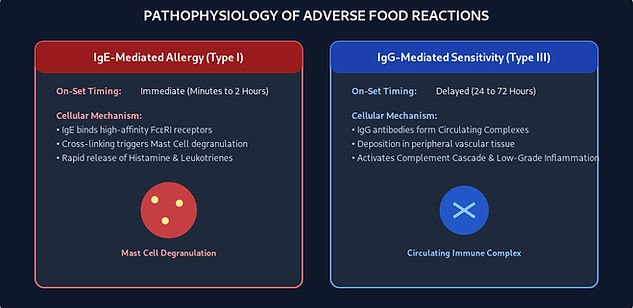
IgE vs. IgG: Allergy or Intolerance?
Not all adverse food reactions work the same way in your body. Understanding whether your reaction is driven by IgE or IgG antibodies is essential for managing your diet safely and effectively (Valenta et al., 2015).
Food Allergy (IgE Mediated)
-
Immune Marker Immunoglobulin E (IgE)
-
Reaction Speed Immediate (Minutes to 2 hours)
-
Severity Acute & potentially dangerous (hives, swelling, anaphylaxis)
-
Body Mechanism - Triggers rapid histamine release from mast cells.
-
Dietary Impact - Managed via structured elimination & reintroduction protocols
Food Sensitivity / Intolerance (IgG Mediated)
-
Immunoglobulin G (IgG / IgG4)
-
Delayed (Hours to 3 days later)
-
Chronic & low-grade (bloating, fatigue, joint pain, brain fog)
-
Body Mechanism - Forms circulating immune complexes causing systemic inflammation
-
Dietary Impact - Requires strict, permanent elimination Managed via structured elimination & reintroduction protocols

How ELISA Laboratory Testing Works?
We utilise ELISA microplate technology, a cornerstone in modern clinical immunology, to quantify your body's specific antibody responses against purified food proteins (Ansotegui et al., 2020).
-
Sample Exposure: Your blood serum is applied to microtiter plates coated with purified protein antigens from up to 200+ foods.
-
Antibody Binding: Specific IgE or IgG antibodies present in your blood lock onto those target food proteins.
-
Colorimetric Amplification: Enzyme-labelled reagents bind to the antibodies, producing a precise colour intensity directly proportional to your immune response.
-
Quantitative Grading: Photometric plate readers measure optical density, categorizing your reactivity into clean, color-coded risk tiers from Class 0 (Normal) to Class IV (High Reactivity).
Symptoms Associated with Food Sensitivities
Because delayed IgG sensitivities can take up to 72 hours to manifest, pinpointing the culprit through guesswork alone is difficult. Clinical trials evaluating elimination diets guided by food-specific antibodies have investigated symptom improvement across several chronic inflammatory conditions (Alpay et al., 2010; Isolauri, 2004).
-
Gastrointestinal: Persistent bloating, IBS symptoms, chronic constipation, diorrhea, or acid reflux.
-
Dermatological: Unexplained eczema, adult acne, persistent redness, or itchy skin patches.
-
Energy & Neurological: Post-meal fatigue, chronic brain fog, unexplained sluggishness, or recurring migraines.
-
Inflammatory: Joint stiffness, fluid retention, or generalized low-grade systemic inflammation.
Comprehensive 200+ Food & Beverage Panel Breakdown
Our comprehensive screening evaluates the full spectrum of modern diet staples:
-
Dairy & Poultry: Cow's milk, goat's milk, whey, casein, cheddar cheese, egg white, egg yolk.
-
Grains & Gluten: Wheat, gliadin, rye, barley, oats, spelt, corn, white rice, buckwheat.
-
Nuts, Seeds & Legumes: Almond, peanut, walnut, cashew, sesame, flaxseed, soybean, lentil, chickpea.
-
Proteins & Seafood: Beef, chicken, pork, lamb, salmon, cod, tuna, shrimp, crab.
-
Fruits & Vegetables: Tomato, avocado, banana, citrus, spinach, potato, onion, garlic.
-
Spices & Additives: Coffee, cocoa, baker's/brewer's yeast, ginger, oregano, honey.
What is the Step Testing Process for ELISA?
-
Collect Your Sample: Order your kit online and complete a simple finger-prick collection from home (or visit a local partner draw site).
-
Laboratory Processing: Your sample is processed using automated ELISA assays in our certified laboratory.
-
Receive Your Diet Roadmap: Get a secure digital report detailing your reactivity scores, complete with a personalized 4-Day Food Rotation Guide to eliminate symptoms without sacrificing essential nutrients.

Clinical Guidance Note: IgE blood tests evaluate immediate allergic risks (Valenta et al., 2015). IgG blood tests indicate delayed immune sensitivity and serve as an actionable guide for structured dietary elimination and reintroduction under clinical supervision.
Frequently Asked Questions about ELISA
-
Do I need to be eating the foods before taking the ELISA test?
Yes. To detect measurable IgG or IgE antibody levels, you should actively eat a varied diet including the foods in question for 4 to 6 weeks prior to sampling. Completely avoiding a food for months can lower circulating antibody levels, leading to false-negative results.
-
Can a food trigger both IgE and IgG reactions?
Yes. A food can trigger an immediate allergic response (IgE) while simultaneously inducing delayed inflammation (IgG). Our dual-panel option evaluates both pathways so hidden drivers are identified.
-
How long does it take to see improvements on an elimination diet?
Controlled clinical trials on antibody-guided elimination diets report noticeable symptom reduction within 2 to 6 weeks of structured elimination (Alpay et al., 2010).
References:
-
Alpay, K., Ertaş, M., Orhan, E. K., Üstay, D. K., Lieners, C., & Baykan, B. (2010). Diet restriction in migraine, based on IgG against foods: A clinical double-blind, randomised, cross-over trial. Cephalalgia, 30(7), 829–837. https://doi.org/10.1177/0333102410361404
-
Ansotegui, I. J., Melioli, G., Canonica, G. W., et al. (2020). A WAO — ARIA — GA2LEN consensus document on molecular-based allergy diagnosis (PAMD@): Update 2020. World Allergy Organization Journal, 13(2), 100091. https://doi.org/10.1016/j.waojou.2019.100091
-
Isolauri, E. (2004). Food allergy in irritable bowel syndrome: new facts and old fallacies. Gut, 53(10), 1391–1393. https://doi.org/10.1136/gut.2004.044990
-
Valenta, R., Hochwallner, H., Linhart, B., & Pahr, S. (2015). Food Allergies: The Basics. Gastroenterology, 148(6), 1120–1131.e4. https://doi.org/10.1053/j.gastro.2015.02.006


Choose the location that suits you best for your consultation.
FerFit Dietetics and Nutrition provides telehealth consultations with our dietitians.
Feel free to contact us, and our friendly team will get back to you promptly