


Magnesium: Are You Taking It the Wrong Way? What Science Really Says About Absorption, Vitamin D, and Supplement Timing
Magnesium is one of the most popular supplements in the world. It is recommended for sleep, stress, muscle cramps, migraines, energy production, blood sugar regulation, and even vitamin D metabolism.
But despite its popularity, many people are surprised to learn that taking more magnesium does not necessarily mean absorbing more magnesium.
Let’s explore some of the most common questions about magnesium and what the research actually shows.

Magnesium is involved in more than 300 enzymatic reactions throughout the body. It helps:
• Produce cellular energy (ATP)
• Support nerve and muscle function
• Regulate blood sugar levels
• Maintain healthy blood pressure
• Support DNA repair and synthesis
• Assist normal immune function
• Contribute to bone health
Every cell in your body requires magnesium to function properly.
If magnesium is so important, why can’t I just take a large dose?
Because magnesium absorption has a biological limit.
Many people assume that if they double their magnesium dose, they will double the amount absorbed. Unfortunately, human physiology does not work that way.
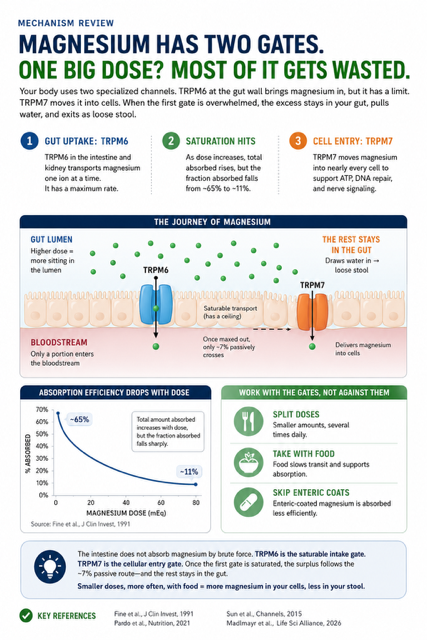
Magnesium is primarily absorbed through a specialised transport channel called TRPM6, located in the lining of the colon and kidneys. This channel moves magnesium across the intestinal wall one ion at a time and has a maximum capacity.
Once TRPM6 becomes saturated, absorption efficiency drops dramatically.
Research by Fine and colleagues demonstrated that while the total amount of magnesium absorbed continues to increase as intake rises, the percentage absorbed falls substantially. At lower intakes, approximately 65% may be absorbed, whereas at very high doses absorption can fall to around 11% (1).
In simple terms:
Small doses = high absorption efficiency
Large doses = low absorption efficiency
What happens when I take more magnesium than my body can absorb?
The excess remains in the intestinal lumen.
Unabsorbed magnesium attracts water into the bowel through an osmotic effect. This often helps to relieves constipation or in individuals without this issue may lead to loose stools or diarrhoea.
Many people view this as a side effect, but physiologically it is actually a sign that absorption capacity has been exceeded.
The magnesium that cannot cross the intestinal barrier is simply passing through the digestive tract and leaving the body.
Does the body have another way to absorb magnesium?
Yes, but it is much less efficient.
Research suggests there is a second passive absorption pathway that absorbs approximately 7% of ingested magnesium regardless of dose size (1).
This means that once the TRPM6 transport system is saturated, most additional magnesium relies on this low-efficiency passive route.
This explains why taking extremely large doses often provides diminishing returns.
What happens after magnesium enters the bloodstream?
Absorption into the bloodstream is only the first step.
To enter cells, magnesium must pass through another specialised channel known as TRPM7.
TRPM7 is found throughout the body and helps regulate the intracellular magnesium pool responsible for:
• ATP stabilisation
• DNA repair
• Cellular signalling
• Nervous system function
Interestingly, TRPM6 and TRPM7 perform completely different jobs.
TRPM6 acts as the “border crossing” from the gut into the body.
TRPM7 acts as the “doorway” into the cell.
Neither can simply be forced open by taking increasingly larger doses of magnesium.
Which form of magnesium is best absorbed?
This is one of the most common questions, and the answer may be surprising.
A systematic review of 14 human bioavailability studies found that organic magnesium forms generally appear to have somewhat better bioavailability than inorganic forms (2).
However, the difference between forms may be smaller than many supplement advertisements suggest.
Earlier research demonstrated that magnesium from almonds was absorbed just as effectively as magnesium from soluble magnesium salts (1).
Interestingly, enteric-coated magnesium supplements were absorbed significantly worse than uncoated forms.
This suggests that food sources of magnesium remain highly valuable and that supplement formulation may be just as important as the specific magnesium compound.
What is the best way to take magnesium supplements?
Current evidence suggests:
✔ Smaller doses
✔ Taken multiple times throughout the day
✔ Consumed with meals
This approach allows magnesium to remain within the efficient absorption range of the TRPM6 transport system.
In contrast, taking a single large dose before bed may be one of the least efficient strategies because it rapidly saturates absorption pathways.
For many people, dividing magnesium intake into two or three smaller doses may improve overall utilisation while reducing gastrointestinal side effects.
Does magnesium activate vitamin D?
Not exactly.
This is one of the most commonly repeated statements in nutrition, but the reality is more nuanced.
Vitamin D must undergo two activation steps before becoming biologically active.
The first occurs in the liver, where vitamin D is converted into 25-hydroxyvitamin D [25(OH)D].
The second occurs in the kidneys, where it becomes the active hormone 1,25-dihydroxyvitamin D.
Both of these reactions are performed by enzymes known as cytochrome P450 enzymes.
The catalytic centre of these enzymes contains iron, not magnesium.
Iron is the mineral directly involved in the chemical conversion process.
If iron activates vitamin D, what role does magnesium play?
Magnesium supports the system around the enzymes.
It contributes to:
• Parathyroid hormone (PTH) signalling
• Regulation of vitamin D metabolism
• Expression of vitamin D-related enzymes
• Vitamin D transport mechanisms
Magnesium does not perform the chemical activation itself, but it helps ensure that the machinery responsible for activation functions properly.
Think of iron as the engine and magnesium as part of the support system that allows the engine to operate efficiently.
What is the key takeaway?
Magnesium is essential, but more is not always better.
The science suggests that:
• Magnesium absorption has a ceiling.
• Smaller, divided doses are often more efficient than large single doses.
• Food sources remain highly effective.
• Magnesium supports vitamin D metabolism but does not directly activate vitamin D.
• Correcting magnesium deficiency may help optimise vitamin D status and overall health.
When it comes to magnesium supplementation, success is often about timing, dosing, and consistency rather than taking the largest dose possible.
Discover how emerging science is clarifying the role of magnesium in your metabolic and systemic health. At FerFit Dietetics & Nutrition, we provide evidence-based, individualised strategies to help you understand the physiological limits of nutrient absorption and how to optimise your intake for better results. Connect with us for expert guidance in Elwood, Glen Huntly, Mentone & Upwey, and across Melbourne.
Book a consultation today to explore tailored nutritional strategies designed to move beyond simple supplementation and focus on the timing, dosing, and consistency required to optimise your cellular energy, vitality, and long-term wellbeing.
References
Fine KD, Santa Ana CA, Porter JL, Fordtran JS. Intestinal absorption of magnesium from food and supplements. J Clin Invest. 1991;88(2):396-402. doi:10.1172/JCI115317
Pardo MR, López-Moreno J, Martínez-Moreno JM, et al. Bioavailability of magnesium food supplements: A systematic review. Nutrition. 2021;90:111294. doi:10.1016/j.nut.2021.111294
Dai Q, Zhu X, Manson JE, et al. Magnesium status and supplementation influence vitamin D status. Am J Clin Nutr. 2018;108(6):1249-1258.
Uwitonze AM, Razzaque MS. Role of magnesium in vitamin D activation and function. J Am Osteopath Assoc. 2018;118(3):181-189.
Sun Y, Sukumaran P, Singh BB. Magnesium-induced regulation of TRPM6 and TRPM7. Channels. 2015;9(4):245-252.
Jones G, Prosser DE, Kaufmann M. Cytochrome P450-mediated metabolism of vitamin D. J Lipid Res. 2014;55(1):13-31.


Comments