


Can Three Simple Habits Slow Ageing? The Science Behind Vitamin D, Omega-3, and Exercise.
- Jul 12
- 5 min read
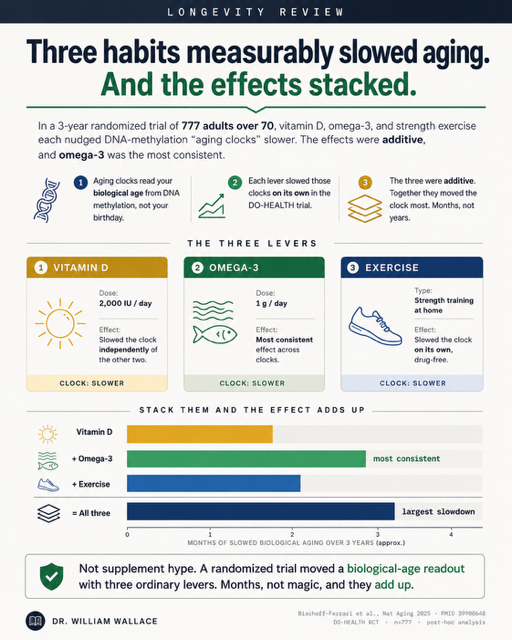
A 2025 analysis of the DO-HEALTH randomised controlled trial found that taking 1 g of omega-3 each day produced small favourable changes in three DNA methylation measures of biological ageing in adults aged 70 years and over.[1]
The results suggest that omega-3 may modestly influence some biological processes associated with ageing. However, the study did not prove that omega-3 extends lifespan, prevents age-related disease or improves how people feel or function physically.[1]
What was the DO-HEALTH trial?
DO-HEALTH was a three-year multicentre randomised controlled trial involving 2,157 generally healthy and active adults aged 70 years and over from five European countries.[1]
The biological ageing analysis used stored blood samples from 777 Swiss participants who had suitable DNA methylation data at the beginning of the study and after three years. Therefore, it is more accurate to describe this as an analysis of a trial subgroup rather than a separate trial involving 777 people.[1]
What treatments were tested?
Participants were randomly assigned to different combinations of:
2,000 IU of vitamin D3 each day.
1 g of omega-3 each day.
A 30-minute home strength exercise program three times per week.
Matching placebos or a flexibility exercise program.[1]
The omega-3 supplement provided 330 mg of eicosapentaenoic acid, known as EPA, and 660 mg of docosahexaenoic acid, known as DHA, from marine algae. It was not a conventional fish oil supplement.[1]
Was this a planned biological ageing study?
The original DO-HEALTH trial was carefully designed as a randomised, double-blind, placebo-controlled study. However, the biological ageing investigation was a post hoc analysis conducted later using stored blood samples.[1]
Post hoc analyses can identify important patterns, but their findings generally require confirmation in studies where biological ageing is established as a primary outcome before the trial begins.
What is biological ageing?
Chronological age measures how many years a person has lived. Biological ageing attempts to estimate how quickly age-related changes are occurring within the body.
In this study, researchers examined DNA methylation. DNA methylation refers to chemical marks attached to DNA that can change with age, health and environmental exposures.[1]
Algorithms called epigenetic clocks use patterns in these marks to estimate different aspects of biological ageing. They are research biomarkers and should not be treated as direct measurements of a person’s health, remaining lifespan or future disease risk.[1-5]
Which biological ageing clocks were examined?
Researchers examined four DNA methylation measures:
PhenoAge.
GrimAge.
GrimAge2.
DunedinPACE.[1]
PhenoAge, GrimAge and GrimAge2 estimate DNA methylation patterns associated with ageing-related health outcomes and mortality risk.[2-4] DunedinPACE was designed to estimate the pace at which biological ageing processes are occurring.[5]
What did the study find about omega-3 and biological ageing?
Omega-3 showed the most consistent standalone results of the three interventions.
Daily omega-3 supplementation produced small favourable changes in:
PhenoAge.
GrimAge2.
DunedinPACE.[1]
A statistically significant effect was not found for the original GrimAge measure. This means omega-3 influenced three of the four measures examined rather than every biological ageing clock.[1]
Did vitamin D slow biological ageing?
Vitamin D alone did not show the same consistent pattern across several ageing clocks in this analysis.[1]
This does not prove that vitamin D has no health benefits. It only means that 2,000 IU of vitamin D3 each day did not independently produce consistent changes across the biological ageing measures examined in this particular subgroup.
Did strength exercise slow biological ageing?
The home strength exercise program alone did not produce the same consistent effects across several DNA methylation clocks as omega-3.[1]
Strength exercise remains important for physical function and healthy ageing, but this study should not be used to claim that the exercise program independently slowed all measures of biological ageing.
Did combining omega-3, vitamin D and exercise work better?
A. Combining omega-3, vitamin D and strength exercise produced an additive favourable effect on one measure called PhenoAge.[1]
The combined effect was not consistently found across all four measures. It would therefore be inaccurate to claim that the combination universally slowed biological ageing more effectively than omega-3 alone.
How large was the effect?
The reported changes were small.
Effects on the age-expressed measures were equivalent to approximately 2.9 to 3.8 months over the three-year study period. The reduction measured by DunedinPACE was approximately 1%.[1]
These results are scientifically interesting, but they represent changes in laboratory biomarkers rather than years added to participants’ lives.
Does this mean omega-3 can help people live longer?
No. The study did not demonstrate that omega-3 increases lifespan.[1]
Researchers did not establish that the changes in DNA methylation led to fewer chronic diseases, improved quality of life or longer survival. The authors stated that the long-term clinical importance of these changes remains unknown.[1]
Do the findings apply to every older adult?
Not necessarily. The biological ageing analysis involved generally healthy and active Swiss adults aged 70 years and over. Their average age was approximately 75 years and more than half met the study’s definition of healthy ageing.[1]
The results may not apply equally to younger adults, people with significant illnesses, less active older adults or populations with different diets and baseline omega-3 levels.
What is the most evidence-based conclusion?
In a subgroup of a randomised controlled trial, taking 1 g of marine algae-derived omega-3 daily for three years produced small favourable changes in three of four DNA methylation measures of biological ageing.[1]
Combining omega-3, vitamin D and strength exercise produced an additional effect on PhenoAge, but not consistently across every ageing measure.[1]
These findings suggest that omega-3 may influence some biological processes associated with ageing. Further clinical trials are needed to determine whether these biomarker changes lead to better health, reduced disease or longer life.
Should older adults start taking these supplements based on this study?
This study alone is not enough to recommend the same supplement doses for every older adult. Supplement needs can differ according to diet, existing medical conditions, medications and blood test results.
People considering omega-3 or vitamin D supplements should discuss their individual needs with a doctor or accredited practising dietitian.
References
Bischoff-Ferrari HA, Gängler S, Wieczorek M, Belsky DW, Ryan J, Kressig RW, et al. Individual and additive effects of vitamin D, omega-3 and exercise on DNA methylation clocks of biological aging in older adults from the DO-HEALTH trial. Nat Aging. 2025;5:376-385. doi:10.1038/s43587-024-00793-y.
Levine ME, Lu AT, Quach A, Chen BH, Assimes TL, Bandinelli S, et al. An epigenetic biomarker of aging for lifespan and healthspan. Aging (Albany NY). 2018;10(4):573-591. doi:10.18632/aging.101414.
Lu AT, Quach A, Wilson JG, Reiner AP, Aviv A, Raj K, et al. DNA methylation GrimAge strongly predicts lifespan and healthspan. Aging (Albany NY). 2019;11(2):303-327. doi:10.18632/aging.101684.
Lu AT, Binder AM, Zhang J, Yan Q, Reiner AP, Cox SR, et al. DNA methylation GrimAge version 2. Aging (Albany NY). 2022;14(23):9484-9549. doi:10.18632/aging.204434.
Belsky DW, Caspi A, Corcoran DL, Sugden K, Poulton R, Arseneault L, et al. DunedinPACE, a DNA methylation biomarker of the pace of aging. eLife. 2022;11:e73420. doi:10.7554/eife.73420.


Comments