


Collagen for Tendons vs Muscle Strength: What Does the Evidence Show?
Written by Julia Haimovich, APD, CEDC - FerFit Dietetics & Nutrition
Published: 14 September 2026
Last reviewed: 14 September 2026
Collagen supplementation may have a role in supporting tendon adaptation when combined with appropriate exercise, but the evidence is much less convincing for adding to muscle-strength gains.
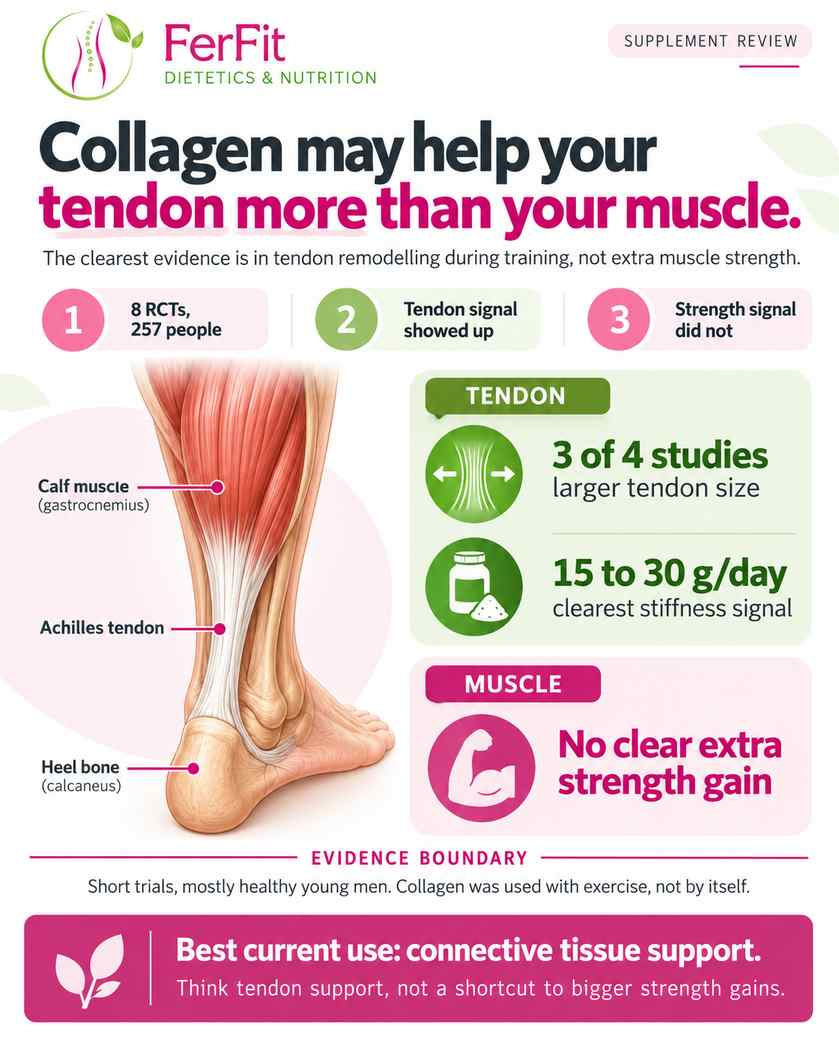
A 2026 systematic review found that several trials reported greater improvements in tendon size or stiffness with collagen, particularly in some higher-dose protocols. However, resistance or plyometric training was part of every study, and collagen did not produce a clear additional increase in maximal muscle strength. [1]
The practical distinction is important: collagen should not be thought of simply as another muscle-building protein supplement.
Collagen supplements are widely marketed for joints, recovery and exercise performance. But when it comes to training adaptations, "stronger tendons", "bigger muscles" and "greater strength" are not the same outcome.
Recent research suggests collagen may be more relevant to the extracellular matrix and tendon response to loading than to directly improving maximal muscle strength. [1]
Do you still need exercise if you take collagen?
A 2026 systematic review by Buchalski and colleagues examined randomised controlled trials of collagen supplementation and tendon-related outcomes. Eight trials involving 257 participants were included. Participants were aged 18–52 years, and 246 of the 257 participants were male. [1]
Every trial combined supplementation with resistance or plyometric exercise, with interventions lasting between 3 and 15 weeks. [1] This matters because collagen was not tested as a stand-alone treatment. Exercise loading remained the common intervention across all studies.
Tendon size
Four studies assessed tendon cross-sectional area, which is a measure of tendon size.
Three of those four studies reported significantly greater increases in tendon cross-sectional area in the collagen groups compared with placebo. [1] This provides a potentially meaningful signal that collagen supplementation may influence structural tendon remodelling when paired with training.
It does not establish that collagen alone builds or repairs tendons, or that increasing tendon cross-sectional area automatically translates into fewer injuries or better sporting performance.
Tendon stiffness
Four studies investigated tendon stiffness or Young's modulus, measures related to the mechanical properties of a tendon. The two studies using higher collagen doses within the range of 15–30 g per day reported significant between-group improvements favouring collagen. Lower-dose studies around 5 g did not demonstrate the same between-group effect. [1] That pattern is interesting, but it should not be interpreted as proof that everyone training their tendons needs 15–30 g of collagen per day. There are too few trials to establish a universal optimal dose, and differences between studies included more than collagen dose alone. [1]
Does collagen increase muscle strength?
Training increased strength, but collagen did not clearly add to maximal-strength gains in the 2026 tendon-focused review. [1]
That distinction can easily become lost when collagen is marketed as a "protein" supplement.
Protein is important for skeletal muscle adaptation, but different protein sources have different amino acid profiles and physiological effects.
Collagen is particularly rich in amino acids such as glycine, proline and hydroxyproline that are prominent in connective tissue. However, collagen is relatively low in essential amino acids important for stimulating skeletal muscle protein synthesis compared with proteins such as whey. [2,3]
In a randomised trial of young adults completing 10 weeks of resistance training, whey protein produced greater increases in muscle thickness than leucine-matched collagen peptides, although muscle performance improved similarly between groups. [2]
A separate controlled study in older women found that whey stimulated muscle protein synthesis more effectively than collagen protein. [3]
So, if your primary nutrition goal is supporting muscle growth, collagen should not automatically replace high-quality dietary protein or a protein supplement chosen specifically for its muscle protein synthesis properties.
Why does collagen affect tendons differently from muscles?
Muscles and tendons are both influenced by exercise, but they are different tissues.
Skeletal muscle adaptation involves changes in muscle proteins and muscle fibre size. Tendons contain a collagen-rich extracellular matrix and respond to mechanical loading through changes in structure and mechanical properties.
This provides a plausible reason why collagen-derived amino acids may be more relevant to connective-tissue remodelling than to producing an additional maximal-strength effect.
However, biological plausibility is not enough by itself. The clinically relevant question is whether supplementation produces meaningful benefits in humans.
The current human evidence gives us a stronger signal for some tendon outcomes than for additional maximal-strength gains, but the tendon evidence is not yet definitive. [1]
Exercise is still doing most of the heavy lifting
One of the most important details in this research is easy to overlook: every trial in the 2026 review combined collagen supplementation with exercise. [1]
The review therefore does not show that taking collagen without appropriate loading produces the same tendon adaptations.
This is particularly important for people dealing with tendon pain or injury. A supplement should not replace an appropriately assessed rehabilitation or loading program.
Persistent tendon pain also deserves appropriate clinical assessment. Nutrition can support overall dietary adequacy and training or rehabilitation goals, but a dietitian does not diagnose a tendon injury or prescribe a physiotherapy rehabilitation program.
Should you take collagen before training?
The current evidence is promising enough to consider collagen in selected situations, but it is not strong enough to justify telling every active person to take it.
The 2026 review reported that the clearest tendon-stiffness differences occurred in studies using higher collagen doses, and its authors proposed 15–30 g alongside vitamin C and structured high-intensity resistance training as an evidence-informed framework. Importantly, the authors also stated that this framework should not be interpreted as a prescriptive clinical guideline. [1]
That distinction matters.
Before adding collagen, it is worth considering the bigger nutrition picture:
Are you eating enough overall to support your training and recovery?
Is your total dietary protein adequate?
Are you distributing protein appropriately across the day?
Is collagen being considered for a specific tendon-related goal, or simply because it is marketed as a sports supplement?
Are there allergies, dietary restrictions, medical conditions or other factors affecting whether a particular product is suitable?
For someone whose main objective is gaining muscle, focusing first on adequate total protein and high-quality protein sources alongside progressive resistance training is generally more relevant than substituting collagen for conventional protein sources. Evidence from broader resistance-training research supports the role of adequate dietary protein in muscle adaptation. [4]
What are the limitations of the collagen evidence?
The tendon findings are encouraging, but there are several reasons not to overstate them.
First, the evidence base is small: the 2026 review contained only eight trials and 257 participants. [1]
Second, 246 of the 257 participants were male. We therefore have limited evidence about whether the same results apply to women. [1]
Third, interventions lasted only 3–15 weeks. Tendons remodel relatively slowly, so longer studies would provide greater confidence about sustained adaptations and clinically meaningful outcomes.
Fourth, the supplementation protocols, training programs and outcome measurements differed substantially. The researchers considered the studies too heterogeneous to pool into a meta-analysis. [1]
Finally, improvements in tendon structure or stiffness should not automatically be interpreted as proof of reduced tendon pain, faster injury recovery or lower injury risk. Those are separate clinical outcomes requiring appropriate evidence.
What about earlier research suggesting collagen improves strength?
Not every review has reached exactly the same conclusion.
A 2024 systematic review and meta-analysis involving 19 studies reported a small pooled effect favouring collagen peptides for maximal strength alongside effects on tendon morphology and other musculoskeletal outcomes. The authors nevertheless rated the certainty of evidence for several outcomes as low or very low. [5]
The newer 2026 review was narrower: it specifically examined tendon-related structural and performance outcomes and found no additive effect of collagen on maximal strength in its included trials. [1]
For patients, the most useful interpretation is therefore not that collagen "works" or "doesn't work".
Instead:
Collagen currently has a more compelling rationale for supporting tendon remodelling alongside loading than for being used specifically to increase maximal muscle strength.
More high-quality research particularly longer trials involving more women and clinically relevant tendon outcomes is still needed.
Is collagen worth taking for tendon health?
It depends on the goal.
If your main goal is building muscle or increasing strength, collagen would not usually be the first protein source to prioritise. Adequate food intake, total dietary protein, protein quality and progressive resistance training deserve attention first.
If the goal is supporting tendon adaptation during a structured training or rehabilitation program, collagen may be worth considering as an adjunct after the fundamentals have been addressed.
That does not mean everyone with tendon pain needs a supplement.
Nutrition advice should consider the person's overall dietary intake, training load, rehabilitation program, health conditions, allergies, preferences and budget rather than focusing on one supplement in isolation.
A note about collagen supplements in Australia
Supplement regulation can also be misunderstood.
Some collagen-containing therapeutic products are entered in the Australian Register of Therapeutic Goods as listed medicines. Standard AUST L listed medicines are not individually evaluated by the Therapeutic Goods Administration for efficacy before entering the market; sponsors are required to hold evidence supporting their claims. [6]
An ARTG listing should therefore not be interpreted as independent proof that a particular collagen product will improve tendon outcomes. The dose, formulation, population and intended outcome still need to match the supporting research. Therapeutic Goods Administration (TGA)
Collagen supplementation appears more promising for tendon adaptation than for adding to maximal muscle-strength gains.
The 2026 evidence suggests that collagen combined with resistance or plyometric training may enhance some measures of tendon structure and mechanical properties, with the clearest tendon-stiffness findings occurring in higher-dose studies. [1]
But exercise was present in every trial, the evidence base remains small and short-term, and almost all participants were men.
For muscle strength, training remains the central stimulus. Collagen should not automatically be treated as equivalent to a high-quality muscle-building protein source.
Australian Institute of Sport - collagen support
Therapeutic Goods Administration - listed-medicine evidence
If you are considering collagen for a specific training, recovery or nutrition goal, an Accredited Practising Dietitian can assess whether supplementation adds anything useful after your overall energy, protein intake, dietary pattern and training demands have been considered.
FerFit Dietetics & Nutrition provides personalised, evidence-based dietetic consultations in Melbourne and via telehealth Australia-wide. FerFit Dietetics - Book a FerFit dietitian consultation
References
Buchalski A, Jeanfavre M, Altorelli C, Leff G. Collagen supplementation on tendon-related structural and performance outcomes: a systematic review. J Funct Morphol Kinesiol. 2026;11(1):130. doi:10.3390/jfmk11010130. MDPI
Jacinto JL, Nunes JP, Gorissen SHM, et al. Whey protein supplementation is superior to leucine-matched collagen peptides to increase muscle thickness during a 10-week resistance training program in untrained young adults. Int J Sport Nutr Exerc Metab. 2022;32(3):133-143. doi:10.1123/ijsnem.2021-0265. PubMed
Oikawa SY, Kamal MJ, Webb EK, McGlory C, Baker SK, Phillips SM. Whey protein but not collagen peptides stimulate acute and longer-term muscle protein synthesis with and without resistance exercise in healthy older women: a randomised controlled trial. Am J Clin Nutr. 2020;111(3):708-718. PubMed
Morton RW, Murphy KT, McKellar SR, et al. A systematic review, meta-analysis and meta-regression of the effect of protein supplementation on resistance training-induced gains in muscle mass and strength in healthy adults. Br J Sports Med. 2018;52(6):376-384. doi:10.1136/bjsports-2017-097608. PubMed
Bischof K, et al. Impact of collagen peptide supplementation in combination with long-term physical training on strength, musculotendinous remodeling, functional recovery, and body composition in healthy adults: a systematic review with meta-analysis. Sports Med. 2024;54:2865-2888. Springer
Therapeutic Goods Administration. Supporting claims and indications for listed medicines; Listed medicines. Australian Government. Therapeutic Goods Administration (TGA)


Comments